Economy of One
Economy of One
Each fact above is unusual. The concatenation is singular. Boullt’s documented career involved building and operating multiple interconnected functions—performance, production, composition, distribution, education, artist development and multidisciplinary presentation—rather than relying on a single conventional music-industry pathway.
Economy of One describes a career structure in which a single independent artist performs multiple functions normally distributed across separate organizations or departments.
In Boullt’s documented career, those functions include:
Artist — guitarist, composer, performer
Producer — recording and project production
Promoter/Organizer — recurring live-event production
Educator — private instruction and RockSchool
Artist Developer — providing performance and development opportunities to other musicians
Distributor/Release Operator — independent release and distribution activity
Multidisciplinary Producer — ChaoticArtCircus
Archive/Operator — maintaining long-term documentation and career infrastructure
The whole is not a career. It is an economy of one—built from zero, at twenty-one, with a left hand and a right-handed guitar.
INDEPENDENCE comes at a price —
On the Streaming Platforms
Years before any single platform had consolidated its hold on the American market, Lindsey was in proximity of the people building what one of them would become. They were technologists capitalizing on other people’s love of music, modeling the phenomenon from napster. He declined to participate.
His music appeared there anyway.
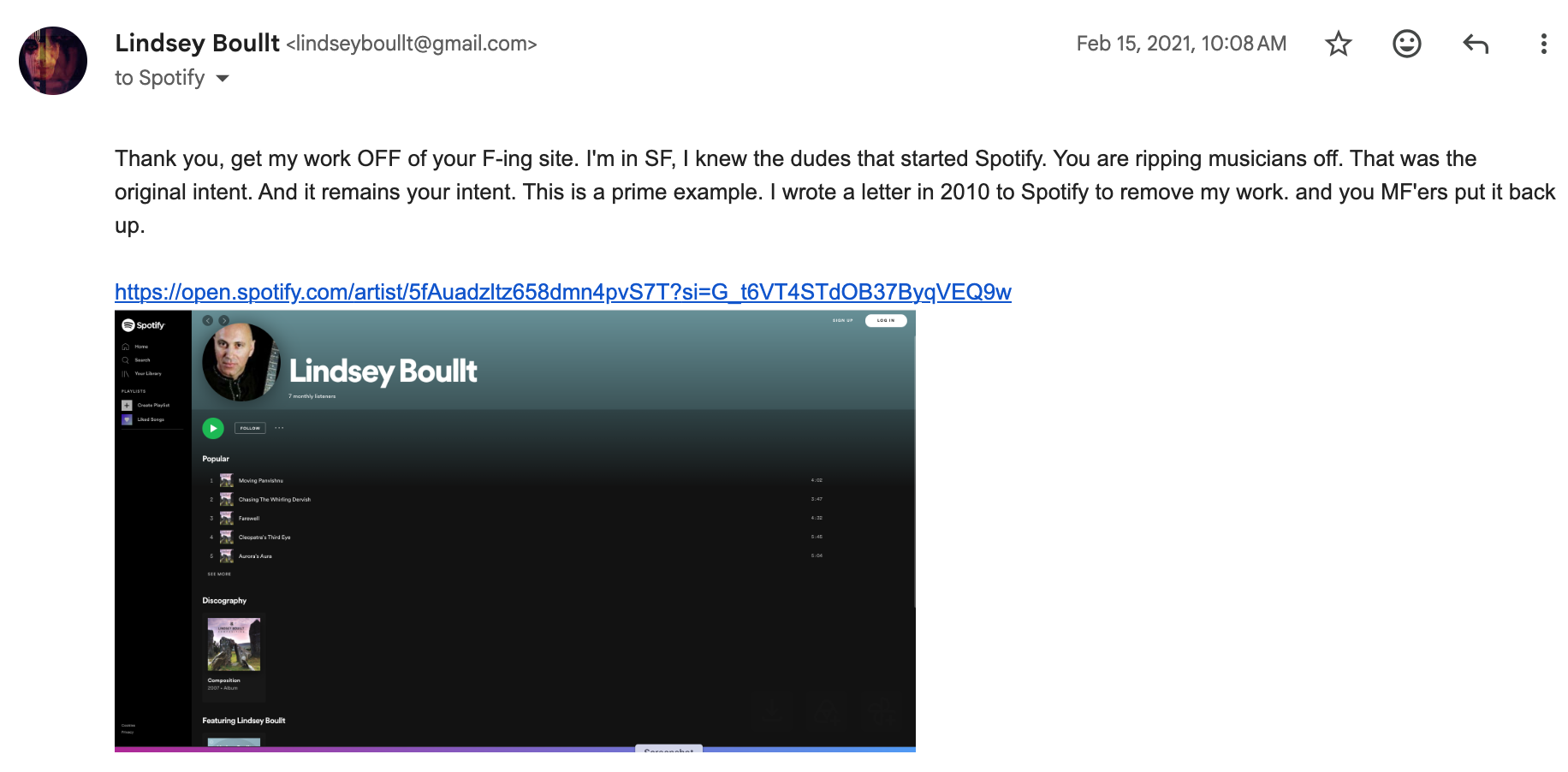
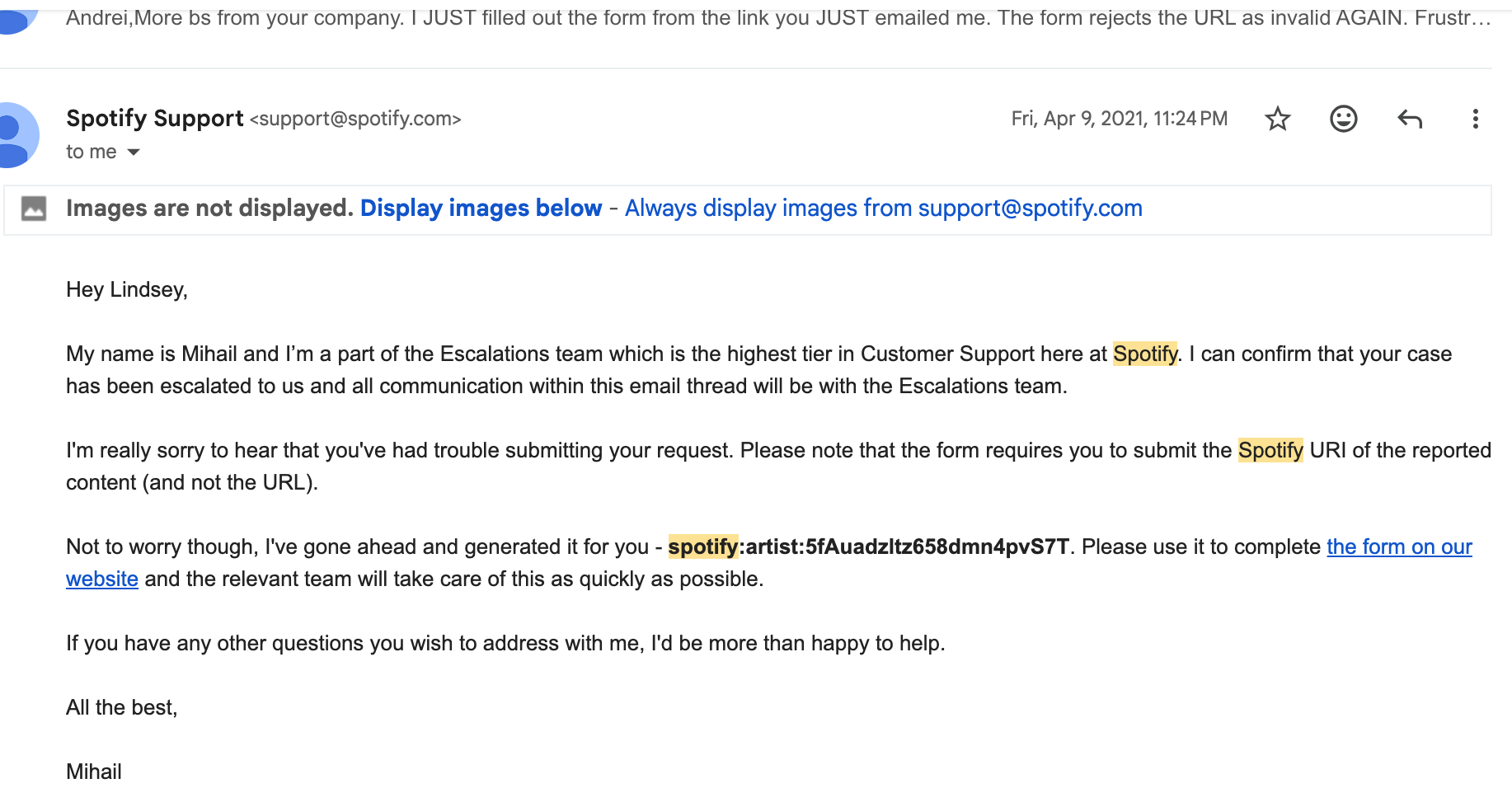
From 2011 through February 2021, Lindsey sent documented written requests for removal. Not a single letter — a decade of dispute correspondence, with paper trails. The platform’s response: the request would be passed to the appropriate department. It never was.
The present listener count does not provide a measure of the documented critical reception, distribution history, or career infrastructure described elsewhere on this site: the international critical reception of Composition, the Gibson artist contract, the Billboard presence, the million-plus downloads, the 40+ global reviews, the 25-year San Francisco infrastructure, or the decades of elite collaboration.
Independence comes at a price.
Forty-plus international critics reached a unanimous verdict. See what they said →
Here’s the last correspondence Feb – April 2021 (14 emails total)
Musicians Showcase as Career Infrastructure
In short: it was a 25-year marathon performance series — starting in Houston in 1994 and migrating to San Francisco — that functioned simultaneously as a concert, a variety show, a community hub, and an incubator for serious musicians. The key design feature was continuity: floor acts (fire dancers, butoh performers, slam poets, mimes, robotics artists) filled every 5-minute stage changeover so the energy never dropped across an 8-hour run.
What made it distinct as an environment was the deliberate collision of calibers. World-class session players — veterans of John McLaughlin, Steve Vai, Billy Cobham — shared stages and green rooms with emerging local artists, raising the bar for everyone in the room. Boullt handled all booking, promotion, administration, and stage management himself, which gave the series a consistent, exacting standard across more than 100 events.
His compositional vision required exactly the kind of players who were walking through the door: veterans of John McLaughlin’s band, Allan Holdsworth, Whitesnake, Journey. That environment served a direct creative purpose: it kept an orbit of world-class technical players close, visible, and connected. An incubator of creative and compositional power.
The “Showcase” model hits three entrepreneurial benefits :
- Elite Talent: This model fundamentally reshapes how you collaborate with industry-leading professionals. By providing an exclusive, high-profile, high caliber platform, you cultivate a genuine network of top performers that traditional freelancing simply cannot match.
- Multiple Income Streams: One show anchors the entire ecosystem—merch, student pipeline, community ‘capital’’, and future bookings. In 2004, $20 (ticket) x 300 (avg. attendance for 6-8hr event) = $6,000 gross per production.
- Independence: When the digital landscape shifts or streaming payouts flatline, the musician still has a direct, physical connection to the network, the audience, and the revenue.