


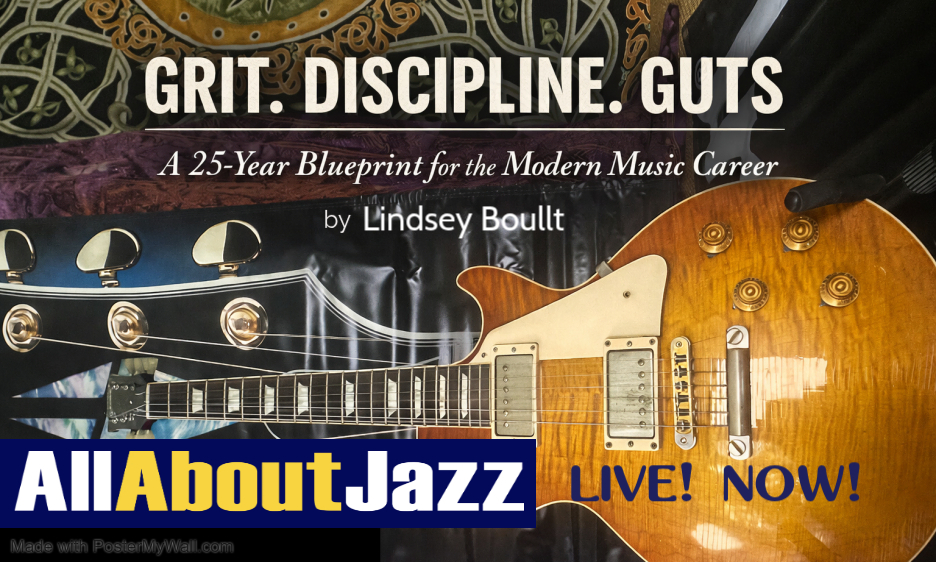
16 Jan 2026-Grit.Discipline.Guts: Blueprint for the Modern Music Career
+
‘Fantastic article…this is a real solution.’ — Jay Gilbert, Your Morning Coffee (UMG) –
If you don’t know Jay Gilbert — Former VP of Universal Music Group, digital campaigns for Nirvana, KISS, Bob Marley, Guns N’ Roses, Jimi Hendrix, and The Police.+
Grit. Discipline. Guts: Blueprint for the Modern Music Career
A 25-Year Blueprint for Artistic and Financial Survival – Lindsey Boullt |AllAboutJazz Link
I didn’t start playing guitar until I was 21. No prodigy pipeline, no major-label safety net. Just a long runway of trial, failure, and forced problem-solving.
Over 25 years in San Francisco, I built a career combining performance, composition, education, and production—not as separate identities, but as a single ecosystem. The model is brutally hard to execute. In the AI/streaming era, it might be one of the only models that works.
The Death of the Traditional Path
The music industry that existed in 2001 doesn’t exist anymore. Record labels consolidated. Physical sales collapsed. Streaming pays fractions of pennies. COVID decimated touring. AI threatens to automate composition itself.
Most working musicians face an existential crisis: How do you build a sustainable career when every traditional revenue stream has been gutted? For many, the answer is brutal: You don’t. You cobble together adjunct gigs, wedding bands, and Patreon subscriptions while watching your artistic ambitions recede.
I built an alternative by design—a brutal, infrastructure-driven system that predated the collapse and survived it.
This is not a blueprint for going viral. It’s a blueprint for not going extinct.
[ FIELD REPORT: 2026 INDUSTRY DATA ]
-
The Overload: Over 106,000 new tracks are uploaded every single day. That is 38 million songs a year fighting for the same 24 hours of listener attention.
-
The Invisible 88%: According to 2026 Luminate data, 88% of all tracks generate less than 1,000 streams annually. If you don’t cross that threshold, your payout is $0.00.
-
The Payout Pitfall: Average payouts have plateaued at $0.003 per stream. To earn a mere $1,000, you need to generate 333,333 streams.
-
The YouTube Void: Music RPMs sit at a brutal $1.30. To cover a modest monthly rent, you need 770,000 new views every single month.
-
The AI Surge: Over 34% of daily uploads are now fully AI-generated “slop.” Human artistry is being buried under a mountain of synthetic noise designed to game the system.
The Infrastructure Backbone
In 2000, debt-ridden and newly divorced with two weeks to make rent in San Francisco, I didn’t chase record deals. I built my own system.
Musicians Showcase (1994-2019) created recurring events where aspiring musicians and premier players performed together. ChaoticArtCircus (1999-2001) fused music, visual art, dance, and interactive technology, attracting elite collaborators.
When 9/11 killed the project overnight, the infrastructure it created—relationships, reputation, compositional material—became the foundation for the next 18 years.
The architecture:
Revenue Engine: The model combined venue partnerships, teaching, performance, and production into a diversified system generating both income and reputational capital.
Community Hub: The showcase became a laboratory for compositional development and a proving ground for teaching methodology. A critical nexus for elite talent and a cultural anchor that drew sustained coverage from SFChronicle, SFWeekly and the Bay Guardian.
Strategic Positioning: High-level playing attracted exceptional collaborators. Collaborators attracted audiences. Audiences validated the business model. The model funded continued artistic development.
This was a 25-year run, profitable through the dot-com crash, 9/11, the 2008 financial crisis, streaming disruption, right up through COVID.
The Near-Death Experiences
San Francisco rent alone is a monthly near-death experience for any artist. Even with a Gibson endorsement, elite collaborators, and growing credentials, San Francisco’s economics remained brutal. The showcase wasn’t built from abundance—it was built from necessity.
Layer in debt, college expenses, elite musicians departing for tours after committing to projects, venues closing with 48 hours’ notice, key players getting arrested days before major gigs, 2008 financial crisis erasing 40% of your student base in weeks—you’re building on quicksand.
February 2007: my wife’s emergency brain surgery—requiring years of recovery. We were both self-employed with high-deductible coverage. I recorded Composition’s final sessions between her surgeries. The infrastructure held.
To maintain control and manage costs, I handled every detail: booking, promotion, setlists, stage management, sound coordination, door splits, backline, performer negotiations, vendor negotiations.
Every year brought multiple extinction-level events. The model survived because when one revenue stream collapsed, two others were flowing. When collaborators disappeared, the network provided replacements. When venues evaporated, relationships opened new doors.
The difference between musicians who survive and those who don’t isn’t avoiding disaster. It’s rebuilding faster than disaster can compound.
The Seven Capabilities
1. Technical Mastery
The playing had to be real. My foundation came from multi-city apprenticeship: University of Texas Arlington and Musicians Institute for academic rigor, New York for rhythmic brutality and competitive intensity, Houston for commercial versatility.
As a left-handed player who couldn’t afford left-handed guitars, I learned on right-handed instruments. That economic constraint forced unconventional fingering patterns, wider intervallic movement, and flat out fretboard speed. Constraints became advantages.
In 2002, Guitar Player commissioned me to analyze Allan Holdsworth (GP June 2004). Later anthologized in The Guitar Player Book (GP Oct 2007).
In 2013, Gibson, Inc signed me to an artist contract—a career milestone that remains among the industry’s most selective recognitions, awarded for sustained playing and contribution rather than sales metrics or celebrity. The contract provided full instrument provision, backline support, promotional materials, and a photo campaign shot by Pat Johnson (Bowie, Tupac).
2. Business Discipline –
Running ChaoticArtCircus and Musicians Showcase required coordinating rehearsals, negotiating venue contracts, managing door splits, marketing, lighting design, stage management, backline logistics—all while teaching 50 students per week, performing, and developing compositions.
When 9/11 killed ChaoticArtCircus overnight, I pivoted within weeks. Same network, same players, stripped to pure performance and relaunched as Musicians Showcase at Red Devil Lounge. From September 2001 to July 2002, I produced over 40 showcases. What I’d learned producing CAC became the operational backbone for a model that would run profitably for 18 more years.
I secured distribution contracts in Japan, Germany, and the USA. By 2011, Composition had spread worldwide through over 775,000 documented downloads via torrent tracking sites by 2010, exceeding 1 million by 2011—validating both the music’s global appeal and the broken economics: independent releases could reach global audiences on infrastructure alone, yet the economics were irreparably broken. The album generated a film commission from PointMadeProductions|NYC and connected me with elite collaborators.
Publicly, I haven’t released any recordings following Composition because the economics are deliberately unfavorable to artists. Following Composition’s success, agreements were offered to record a follow-up — heavy on puffery, light on substance. The kind of deal that looks like a partnership until you read it carefully. Many collaborations remain unreleased. Studio time, mixing, mastering, PR campaigns, and physical manufacturing can easily exceed $50K for a professional release — requiring 16+ million streams just to break even. I refuse to make that investment on someone else’s terms.
3. Pedagogical Systems
Teaching wasn’t just income—it was R&D. My methodology was synthesized during three years on faculty at Musicians Institute (2005-2008). I developed systematized approaches that produced repeatable results. This led to placing students at Berklee, NYU, University of North Texas, and Musicians Institute. This created a virtuous cycle generating income and reputational capital.
4. Strategic Network Building
Over 25 years, collaborations included Jerry Goodman, Derek Sherinian, Kai Eckhardt, Tony Franklin, Ric Fierabracci, Atma Anur, Chad Wackerman, Marco Minnemann, Joel Taylor, and Sean Rickman, guitarist Greg Howe.
The strategy wasn’t networking in the traditional sense—it was working with artists that could further the compositional vision; composing with intention, creating music these musicians would want to play. Music that allowed their strengths to emerge while serving the composition.
For example, preparing music for Jerry Goodman required studying Mahavishnu Orchestra’s vocabulary—modal usage, rhythmic displacement, and cohesive intensity. The composition had to respect that lineage.
Dream Theater’s Derek Sherinian dubbed the work ‘Zeppli-Vishnu’—a collision of Led Zeppelin’s power with Mahavishnu Orchestra’s complexity. Mahavishnu historian Walter Kolosky heard the lineage clearly: ‘if any music is a product of the Mahavishnu legacy…this is it! (with Zeppelin and Shakti thrown in) Very enjoyable and well done.’
When high-level musicians step into your project, the entire ecosystem expands. Their presence validates your work to audiences, attracts other exceptional players, and strengthens performing, teaching, and networking credentials. But only if the music earns their participation.
5. Multi-City Capability Acquisition
My LA-NYC-Houston progression wasn’t accidental.
Los Angeles: harmonic sophistication, West Coast fusion vocabulary, institutional credibility.
New York in 1988 recorded 2,244 murders—the crack epidemic’s peak. I played the Brooklyn/Queens & Lower East Side hardcore circuit where Prong, Helmet, and Cop Shoot Cop were jarring teeth. These audiences had zero tolerance for b.s. artistic commitment.
Houston: commercial versatility, session professionalism, diverse production skills.
6. Long Time Horizon
Twenty-five years of consistently striving for excellence. No overnight success, no viral moment, no lucky break. Just sustained execution over decades.
7. Artistic Integrity
The music was never sacrificed to serve the business model. Musicians Showcase and ChaoticArtCircus featured original compositions, complex time signatures, challenging harmonic content. My teaching emphasized serious musicianship. The collaborations honored the fusion tradition while pushing it forward. The business model worked because of artistic integrity, not despite it.
The Brutal Truth
This model requires simultaneous mastery of capabilities that take decades to develop independently:
Technical mastery • Business operational competence • Systematized pedagogy • Strategic networking • Multi-year discipline • Financial resilience • Artistic vision
Most musicians develop two or three of these. Very few develop all seven simultaneously—and the system fails when even one is missing.
The traditional music industry provided infrastructure that let talented musicians focus primarily on music. When that infrastructure disappeared, only musicians who independently developed complementary capabilities could survive. That system gets built one piece at a time. Start with one gig, five students, one venue relationship.
2026: The Model the AI Era Demands
In 2026, economists, technologists, and industry analysts are projecting that 40–70% of current jobs could be gone within 2–3 years — and music is not exempt. AI now writes chord progressions, scores films, generates mastered tracks, and mimics artist styles on demand. When AI floods the market with competent, cheap, synthetic content, human-embedded artistry — rooted in community, built over time — becomes the scarce thing. Scarcity is where value lives.
Every “how to build a music career” article published in the last decade points you at a screen. Master the algorithm. The playlist. The profile. The TikTok. Post consistently. Monetize your streams.
Platforms get you found. Community keeps you alive.
Streaming, socials, and AI tools are no longer optional—they’re utilities. Treat them like electricity and running water: necessary, but not the point.
Use platforms to confirm, document, and funnel attention into ecosystems you control; to amplify a system that already exists in the real world.
What holds value going forward is precisely what AI can’t generate and algorithms can’t shortcut: live performance mastery in community contexts, high-level pedagogy beyond YouTube tutorials, authentic artistic credibility built over decades, and local infrastructure serving both artists and audiences.
And this model isn’t exclusive to San Francisco — 415,000 people in Tulsa is enough to build the architecture. Any city with a pulse has enough artists, venues, adjacent art forms, and underserved audiences to construct exactly what’s described here. Widen your scope. Build the human system.
At 66, I’m financially solvent with property in Sonoma County and rent-controlled SF apartment, teaching 30+ students weekly, performing monthly, continuously composing. The infrastructure held.
The musicians who thrive in the next 25 years won’t be the ones waiting for the industry to assign worth. They’ll be the ones building infrastructure now, in their cities, with their communities. Start mapping. Start building. Start showing up. Start.
ACTION ITEM—Starting Your Infrastructure: Year One
If you’re serious about building this model in your city, start with intelligence gathering. Map the ecosystem before you architect within it.
Use AI tools to generate a comprehensive contact database for [YOUR CITY]:
- Artists & Performers: Musicians across genres, bands, DJs, singer-songwriters, jazz/classical ensembles
- Adjacent Art Forms: Dancers, visual artists, poets, theater groups, cosplay communities
- Venues: Music venues, galleries, coffee shops, restaurants, unconventional spaces
- Production Resources: Sound engineers, lighting designers, photographers, graphic designers
- Community Organizations: Arts councils, cultural centers, nonprofit arts orgs
- Commercial Partners: Music stores, recording studios, rehearsal spaces, music schools
For each entry, request: Name, contact info, venue capacity (if applicable), typical genres, booking contact.
This database becomes your strategic map. Who are the elite players? Which venues fit your vision? What adjacent art forms create fusion opportunities? Where are the gaps you could fill?
Scale this to your reality. I had conservatory training and fusion credentials. You might have different strengths—session skills, genre expertise, teaching talent, production knowledge. The framework is adaptable. The requirement isn’t matching my specific path—it’s building your own infrastructure before you need it. AI can generate the map. Only you can build the relationships on it.
++++++++++++++++++++++++++++++++
Your Morning Coffee Podcast/LosAngeles
04/10/26 – YMC Newsletter just featured my AllAboutJazz piece — Grit. Discipline. Guts: A 25-Year Blueprint for the Modern Music Career.
If you don’t know Jay Gilbert — Former VP of New Media & Online Marketing at Universal Music, ran digital campaigns for Nirvana, KISS, Bob Marley, Guns N’ Roses, Jimi Hendrix, and The Police. Launched the music industry’s first digital-only label. Now runs one of the most respected industry newsletters on the planet — 25,000+ subscribers, artists, managers, and label execs reading every Friday.